
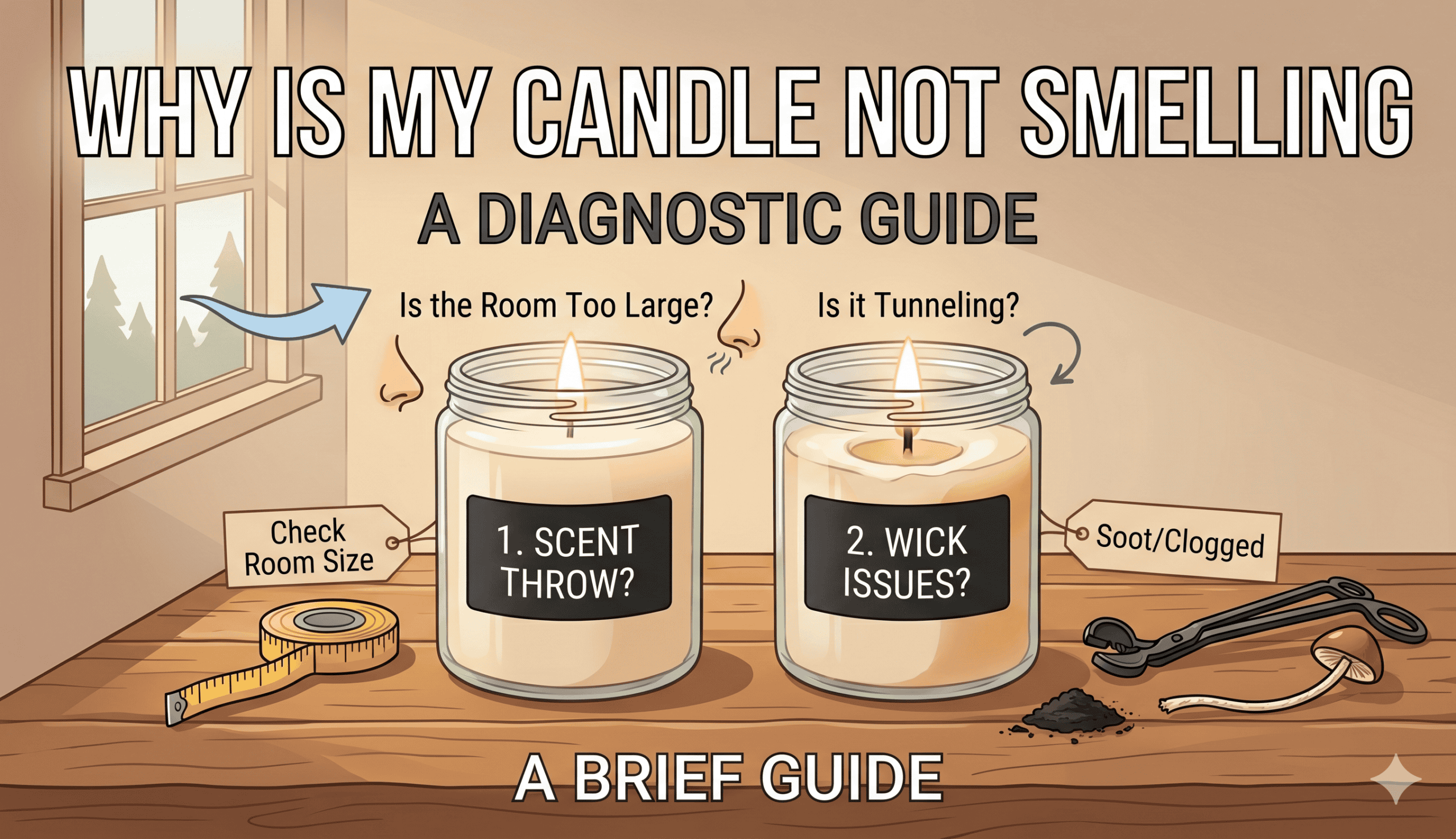
Why Is My Candle Not Smelling? 7 Reasons & How to Fix It
A candle that won’t throw scent usually has one of these problems: the melt pool is too small, the room is too large, the wax is low quality, the fragrance load is low, or the wick is the wrong size. Most are fixable, and the biggest factor is the quality of the wax.
7 Reasons Your Candle Isn’t Throwing Scent
| # | Reason | Fixable? |
|---|---|---|
| 1 | Melt pool too small | ✅ Yes , burn longer |
| 2 | Room too large for the candle | ✅ Yes , move to smaller room |
| 3 | Low-quality wax (cheap paraffin) | ❌ No , wax can’t be changed |
| 4 | Low fragrance load | ❌ No , set during manufacture |
| 5 | Wick too small | ⚠️ Partially , affects melt pool |
| 6 | Scent fatigue (nose got used to it) | ✅ Yes , leave the room and return |
| 7 | Candle burned past its fragrance life | ❌ No , replace candle |
1. The Melt Pool Is Too Small
The most common fixable cause. Fragrance is released from the melted wax surface; the larger the melt pool, the more scent is released. If you’ve only burned the candle for 30 minutes, only a small pool around the wick has melted, and very little fragrance is escaping.
Fix: Burn the candle until the melt pool reaches the full edges of the jar, 2–3 hours for an 8-oz candle. This also prevents tunnelling.
2. The Room Is Too Large
A single 8 oz candle is designed to scent a small-to-medium room (up to roughly 100–150 sq ft). In a large open-plan space, the fragrance dissipates before it can build up.
Fix: Move the candle to a smaller, more enclosed room, or use multiple candles in a large space. Close doors to contain the scent.
3. The Wax Is Low Quality
This is the cause people least want to hear because it can’t be fixed. Cheap paraffin candles often have poor hot throw; they smell strong when unlit (cold throw) but release little fragrance when burning.
| Wax | Hot Throw (scent when burning) |
|---|---|
| Coconut soy | Excellent |
| Pure soy | Good |
| Paraffin | Variable; often weak |
There’s no fix for an existing low-quality candle, but for future purchases, choose coconut soy candles, which release fragrance gradually and consistently as they burn.
4. The Fragrance Load Is Too Low
Fragrance load is the percentage of fragrance oil by weight in the candle. Quality candles use 8–10%. Budget candles sometimes use as little as 3–4% to cut costs, which produces a candle that looks fine but barely smells.
Fix: Not fixable in an existing candle. Buy from makers who use a proper fragrance load. All Gist of Light candles use a full fragrance load tested for throw from first burn to last.
5. The Wick Is the Wrong Size
A wick too small for the jar produces a weak flame and a small melt pool, resulting in a weak scent throw. (A wick too large causes other problems: soot, fast burning, overheating.)
Ensuring the wick is trimmed to ¼ inch and the candle burns to a full melt pool gives the existing wick its best chance.
6. Scent Fatigue (Your Nose Adapted)
Olfactory fatigue is real: after 15–20 minutes in a scented room, your nose stops registering the smell. The candle is throwing off a scent; you’ve just adapted to it.
Fix: Leave the room for 10 minutes and return. If you notice the scent on re-entry, the candle is working fine; your nose was just acclimatized.
7. The Candle Has Burned Past Its Fragrance Life
If a candle has been burning for many hours over its life and the scent has gradually faded, the fragrance oil may simply be exhausted, even if the wax remains.
Fix: Not fixable. With a quality candle and proper fragrance load, scent should last the full burn life, but very long total burn time eventually depletes the oil.
How to Make a Candle Smell Stronger
| Tip | Effect |
|---|---|
| Burn to a full melt pool | Maximises fragrance-releasing surface |
| Use in a smaller, enclosed room | Concentrates the scent |
| Trim the wick to ¼ inch | Optimises flame and melt pool |
| Burn for 2–4 hours | Lets the scent build up |
| Keep away from draughts | Prevents fragrance being blown away |
| Buy coconut soy, full fragrance load | The biggest factor in scent throw |
See our candle care guide.
Match the Candle to the Room
A scent-throw problem is sometimes just a math problem. A small 4 oz candle can fill a bathroom or home office; in an open-concept living room with high ceilings, the same candle is undetectable; the fragrance is there, just diluted into too much air. As a rule of thumb: small candles for small rooms, 8 oz+ for bedrooms and standard living rooms, and multi-wick or multiple candles for large open spaces.
Competing Smells Cancel Each Other Out
Candle fragrance is fragile in a busy-smelling room. Burn a floral candle in the kitchen an hour after cooking dinner, and the two scents fight; the result reads as “muddy” or as nothing at all. Test a candle you suspect is weak in a closed, odour-neutral room before blaming the candle.
(And a definition aside, because the terms help: cold throw is how a candle smells unlit in the jar; hot throw is how it fills a room while burning. A candle can have great cold throw and weak hot throw; that’s usually a wick or wax-quality issue, not your nose.)
Frequently Asked Questions
Why does my expensive candle not smell?
Even expensive candles need a full melt pool to throw scent. If it’s burning to the edges in a small room and still weak, the fragrance load or wick may be the issue. Some “luxury” candles prioritize subtle scent by design.
How do I get my candle to smell stronger?
Burn it until a full melt pool forms in a small, enclosed room, with the wick trimmed to ¼ inch. These maximize the existing candle’s throw.
Do soy candles smell as strongly as paraffin?
Coconut soy candles often throw scent better than paraffin while burning (hot throw), though paraffin can smell stronger unlit (cold throw). For room-filling fragrance during use, coconut soy is excellent.
Why is my candle strong when unlit but weak when burning?
This is a classic sign of low-quality wax (often paraffin) with poor hot throw, or of a fragrance oil not well suited to the wax. Coconut soy with a fragrance oil that has been tested avoids this.