
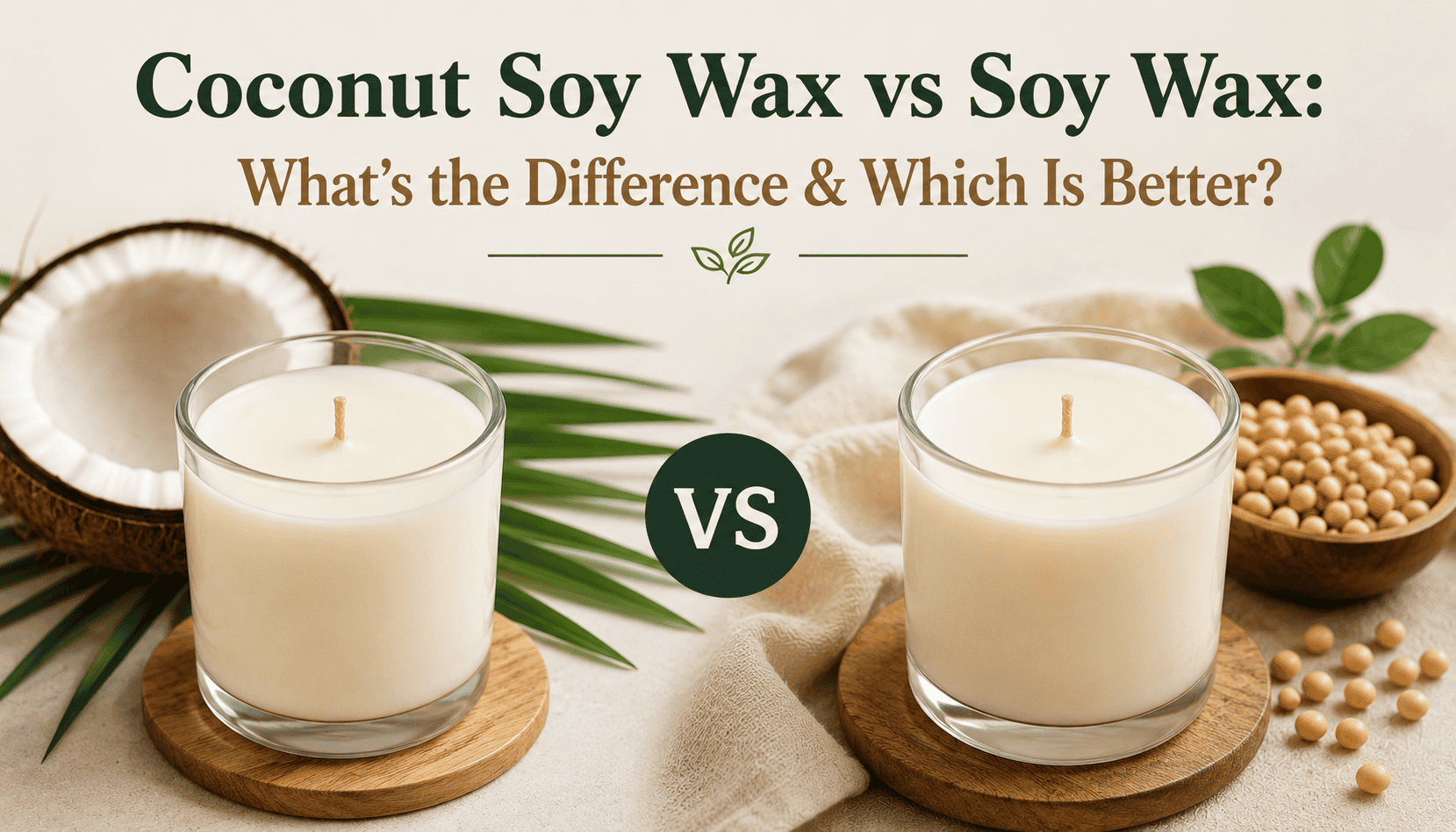
Coconut Soy Wax vs Soy Wax: What’s the Difference & Which Is Better?
Coconut soy wax is a blend of coconut wax and soy wax. It burns more slowly, holds fragrance better, produces a creamier texture, and delivers a stronger, more consistent scent throw than pure soy wax. It’s considered a premium upgrade from standard soy and a significant step above paraffin.
Coconut Soy Wax vs Soy Wax vs Paraffin, Full Comparison
| Feature | Coconut Soy | Pure Soy | Paraffin |
|---|---|---|---|
| Burn time | Longest | Long | Shortest |
| Scent throw (hot) | Excellent | Good | Moderate |
| Scent throw (cold) | Good | Moderate | Excellent |
| Clean burn | ✅ Very clean | ✅ Clean | ⚠️ Some soot |
| Phthalate compatibility | Phthalate-free capable | Phthalate-free capable | Often contains phthalates |
| Texture | Creamy, smooth | Can be rough / grainy | Hard, waxy |
| Frosting (wax blooming) | Minimal | Common | None |
| Scent complexity retention | Excellent , preserves top notes | Good | Poor , top notes burn off fast |
| Environmental impact | Plant-based | Plant-based | Petroleum byproduct |
| Cost | Premium | Mid-range | Low |
| Common in mass-market candles | No | Some | Yes |
What Is Coconut Wax?
Coconut wax is extracted from the meat of coconuts; it’s a natural, plant-derived wax that is harder and denser than soy wax on its own. Its key properties:
- Because it has a lower melting point than soy, the wax pool forms faster and more completely, which is exactly why coconut wax burns more efficiently and releases fragrance at lower temperatures. (Blends add soy for structure, so the finished candle stays stable at room temperature.)
- Excellent fragrance retention, holds fragrance oil with more consistency than soy
- Creamy, smooth texture, coconut wax candles have a luxury aesthetic that’s difficult to achieve with soy alone
- Very clean burn, even lower soot output than pure soy
Blended with soy wax, these properties are balanced with soy’s availability and workability. The result, coconut soy, is widely considered the best all-round wax for premium scented jar candles.
Why Coconut Soy Delivers Better Scent Throw
This is the most important difference for anyone buying a scented candle. Scent throw, how well the candle fills a room with fragrance, depends on how fragrance oil releases from the wax as it burns.
| Wax | How Fragrance Releases | Result |
|---|---|---|
| Paraffin | Burns hot; releases fragrance quickly | Strong initial throw; fades fast; top notes burn off |
| Pure soy | Burns medium; reasonable fragrance release | Decent throw; some complexity loss over time |
| Coconut soy | Burns cool and slow; fragrance releases gradually | Consistent throw from first to last burn; full complexity preserved |
For complex fragrances, a strawberry shortcake dessert candle with top notes of fresh fruit, heart notes of vanilla sponge, and base notes of cream, made with coconut soy wax, is significantly better at preserving that complexity throughout the burn.
Is Coconut Soy Wax Better for the Environment?
Both coconut and soy are plant-derived, renewable, and biodegradable, a clear improvement over paraffin, which is a petroleum byproduct.
| Environmental Factor | Coconut Soy | Paraffin |
|---|---|---|
| Source | Coconut + soybeans (plant-based) | Petroleum (fossil fuel) |
| Biodegradable | Yes | No |
| Renewable | Yes | No |
| Carbon footprint | Lower | Higher |
Coconut farming does have land-use considerations, but the environmental profile of coconut soy is considerably better than that of paraffin.
Why Gist of Light Uses Coconut Soy Wax
Every candle we pour is made with a premium coconut soy wax blend. The reasons:
- Better scent performance: our fragrance profiles (dessert, floral, holiday) are complex and layered. Coconut soy preserves that complexity better than any alternative.
- Longer burn time: our 8 oz candles reach 45–55 hours because of the wax, not despite it.
- Cleaner burn, no soot on jars, no petroleum byproducts, no toxins in the air.
- Better aesthetics: the creamy, smooth set of coconut soy wax looks premium in the jar and holds botanical embeds better.
- Honest ingredient choice, we could use cheaper wax. We don’t.
All Gist of Light candles are hand-poured in Kelowna, BC and shipped across Canada and to the USA.
The Honest Downsides of Coconut Soy
No wax is perfect, and pretending otherwise is how you end up disappointed. The real trade-offs:
- It costs more. Coconut wax is one of the most expensive candle waxes on the market; expect coconut soy candles to sit at a premium over plain soy from the same maker.
- It’s a softer wax. Pure coconut wax is too soft to hold its shape on its own (which’s why it’s always blended). A coconut soy candle left in a hot car in July will suffer more than a paraffin pillar would.
- It’s harder to find. Most mass-market candles are made with paraffin or plain soy because they are cheap and easy to work with at scale. Coconut soy stays mostly in the artisan and luxury tiers.
For most people burning candles at home, none of these outweigh the burn quality, but if you need a candle to survive a heatwave in a parked car, now you know.
Which Is Better for Candle Making?
If you landed here because you’re pouring your own, coconut soy blends are more forgiving than pure soy in two ways: far less frosting (that white crystalline bloom soy is famous for) and smoother tops without a heat gun. The trade-offs are cost per kilogram and slightly slower setting times. Pure soy remains the budget-friendly learning wax; coconut soy is what you graduate to when scent throw and finish start mattering more than material cost.
Frequently Asked Questions
Is coconut soy wax better than regular soy?
Yes, in most measurable ways: burn time, scent throw quality and consistency, texture, and retention of fragrance complexity. The trade-off is cost; coconut soy is more expensive than pure soy.
Is coconut soy wax natural?
Both coconut and soy wax are plant-derived and natural, significantly cleaner than paraffin. Neither is 100% “all-natural” in the strict sense once blended and processed, but both are genuinely plant-based.
What candle wax has the best scent throw?
For hot scent throw (while burning): coconut soy. For cold scent throw (unlit): paraffin. For the best overall fragrance experience with a full burn, coconut soy wins by a significant margin.
Are coconut soy candles non-toxic?
When made with phthalate-free fragrance oils (as all Gist of Light candles are) and coconut soy wax, yes, they produce minimal soot, no petroleum byproducts, and no phthalates.
Where can I buy coconut soy candles in Canada?
Gist of Light hand-pours coconut soy candles in Kelowna, BC and ships across Canada and to the USA.